You’re Not Failing at Getting Better: Healthism and Chronic Illness
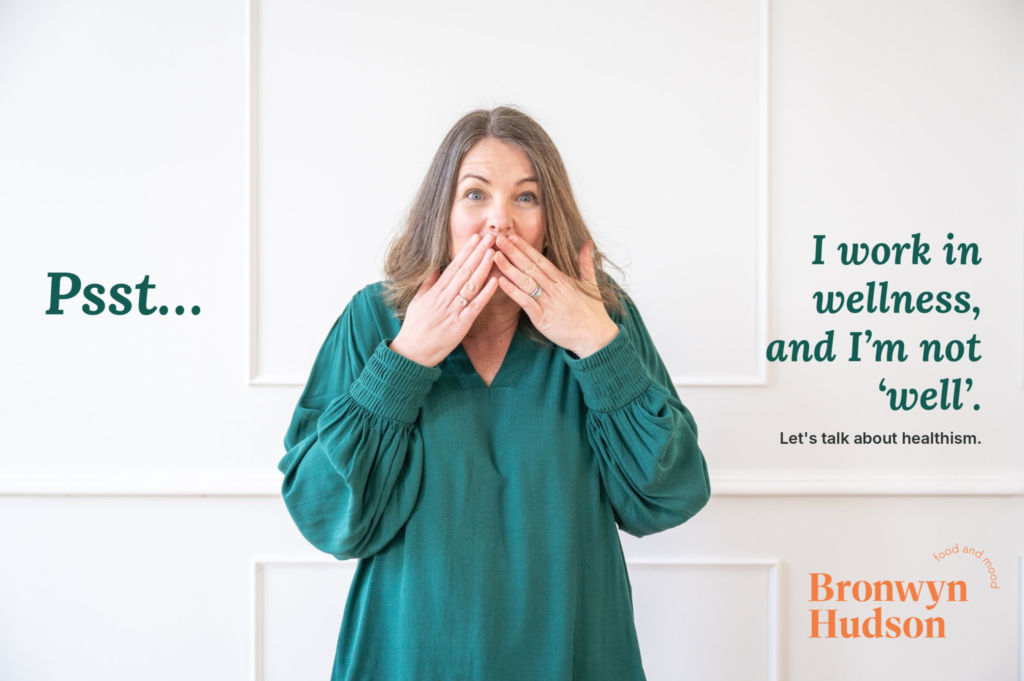
If you live with chronic illness and sometimes quietly wonder if it’s your fault you’re not better yet, this one’s for you.
I know that question well.
When I was first diagnosed with Complex Regional Pain Syndrome (CRPS), I saw it as a personal failing. I’m a nutritionist and master health coach. Trained in lifestyle and functional medicine. I know this stuff. Surely, with everything I know, I shouldn’t have ended up here.
Then came a second belief, quieter but just as heavy. I’d be the exception. Whatever happened to other people with this condition wouldn’t happen to me. My mindset, my resilience, my tenacity and my knowledge would see to that. I’d kick this to the curb.
So I did everything ‘right’. Everything the specialists told me to do (or at least everything that I heard and related to). I had an incredibly knowledgeable team around me. And it kept spreading anyway. What started in my left and foot ankle moved to my left knee, then all the way up my leg to my hip. Symptoms mirrored to my right foot/ankle. I felt like a complete failure.
What I didn’t see then was how much extra weight those beliefs added. The pain was hard enough. On top of it sat the guilt of having “let” it happen, and the pressure of needing to beat it. Each flare didn’t just hurt. It felt like proof I was failing.
Those beliefs didn’t come from nowhere. They came from a story our culture tells about health, one I’d absorbed through years of living, working and breathing in the wellness space. And that story has a name.
What healthism is
Back in 1980, American sociologist Robert Crawford gave it a name: healthism. Basically, it’s the belief that health is a personal virtue. Something you earn through discipline and good choices, and lose through laziness or poor ones.
On the surface, it sounds empowering. Take charge of your health! And caring for our bodies matters. But healthism goes a step further. It turns health into a measure of character. Healthy people become “good”. Unwell people become people who didn’t try hard enough.
You see it everywhere once you start looking. In before-and-after photos. In “no excuses” fitness slogans. In wellness messaging that promises you can heal anything with the right protocol. In food labelled “good” or “bad”, “clean” or “junk”, as if what we eat says something about our worth. In the way larger bodies get judged as lazy or undisciplined, while smaller bodies get assumed healthy and praised as disciplined, even when weight loss comes from illness, stress or struggle. Either way, the judgement says nothing about someone’s actual health or habits. And for most people, that story mostly works, or at least doesn’t hurt much.
It also quietly assumes we all start from the same place: that everyone has equal access to safe exercise, fresh food and medical care. We don’t.
For people living with chronic illness, it can be crushing.
How it shows up when you live with chronic illness
Chronic illness rarely follows a neat recovery story – man I wish it did. Many conditions fluctuate, plateau or progress no matter how well someone looks after themselves. But healthism only has room for one storyline: try hard, get better. So when your body doesn’t follow the script, the story points the finger at you.
It can sound like guilt when progress stalls, symptoms progress or remission isn’t achieved. It can look like comparing yourself to the person online who is ‘healed’ and wondering why you haven’t. It can feel like rest has to be justified, or earned.
It also shows up in other people. Well-meaning advice: “Have you tried…?” “You just need to…” “I had something similar and I got better.” Usually it comes from a good place – I know that and appreciate all the ways people in my life show they care. But it can also leave you feeling that someone else knows better than you what your body needs, without seeing what your days actually look like.
Over time, that adds up. Guilt. Self-blame. Shame. Anxiety. Burnout from chasing the next fix, especially when so much of what’s happening is outside your direct control. And sometimes giving up on support altogether, because every conversation about health feels like being judged.
Why we blame: the comfort of control
So why is this story so sticky? A big part of it is fear.
None of us wants to be the person who ends up with a chronic condition or to lose our mobility. And it’s frightening to admit how much of that comes down to luck, genes and circumstance. So, often without realising it, we look for a reason. If they caused it, then I can avoid it.
This is where my inner nerd gets a bit curious, because psychology actually has names for this. Melvin Lerner described our deep need to believe in a just world, where people get what they deserve. Ellen Langer showed how we overestimate how much control we have, even over things that are down to chance. And writer Susan Sontag, after her own cancer diagnosis, described how stories that blame the patient say more about our fear of illness than about the illness itself.
Looking back, I was a textbook example of this. Believing I’d be the exception, because of what I knew and how hard I’d try, was the illusion of control at its purest. It felt like strength. In hindsight, it was also a way of not facing how little of this was ever mine to control.
Wellness culture leans on this hard. Much of it is selling a sense of control: do these things and you won’t end up there. That’s comforting to buy. But it comes at a cost to anyone whose body shows that control has limits.
Knowing this can maybe soften things a little. I’ve found that. When someone’s advice or judgement lands heavily, it often isn’t really about you. It’s their fear, their discomfort. And it’s not yours to carry.
Health isn’t only individual
There’s another sneaky assumption baked into healthism: that health belongs to the individual alone. But that’s just one cultural lens, not the whole truth.
In te ao Māori, health has long been understood as collective and relational. It’s held within whānau, connected to whakapapa, whenua and wairua. Wellbeing isn’t something one person earns on their own. It’s shaped together, and across generations.
Healthism also hides the bigger picture. Take type 2 diabetes. It’s often called a “lifestyle disease”, which quietly suggests personal failure. But what we eat and how we live are shaped by food environments, income, housing, stress, racism and access to care. For Māori, those are tied to a history of colonisation, including the loss of land and traditional food systems. In 2019, the Waitangi Tribunal’s Hauora report found the Crown had breached Te Tiriti o Waitangi in how primary health care was designed and delivered.
When we blame individuals for outcomes shaped by systems and history, we add stigma on top of illness. And stigma keeps people away from the care and support they deserve.
None of this means our choices don’t matter. They do. Of course they do. But they sit inside a much bigger story.
What’s in your control, and what isn’t
Letting go of healthism doesn’t mean giving up. It means getting clear. Some of your health is in your control. Some of it isn’t. Both can be true, and knowing the difference is where the real power is.
I’ve had to learn this myself – the hard way. I used to believe that if I just did enough, I’d get better. Now (as much as I can) I put my energy where it actually makes a difference, and (on my good days) I let go of carrying blame for the rest.
Meditation teacher Shinzen Young sums it up in a simple formula: suffering = pain × resistance. Psychologist Russ Harris talks about something similar in acceptance and commitment therapy (ACT). When we struggle against our discomfort, we add a second layer of suffering on top: the guilt, frustration and self-blame.
I want to be careful here, because this idea can be twisted into more healthism: “you’re only suffering because you’re resisting.” That’s not it. Your pain and/or symptoms are real, and they aren’t your fault. For me, the resistance wasn’t to the pain itself. It was to my expectation of who I should be: the one who’d beat this. Letting go of that expectation didn’t take the relentless pain, burning, temperature changes, colour changes and other weird symptoms of this condition go away. But it lifted a weight I never needed to carry. And that part was in my control.
A really simple place to start is sorting things into three groups:
|
In my control |
I can influence |
Not in my control |
|---|---|---|
|
How I pace my energy |
How others support me |
My diagnosis |
|
What I eat most days |
My access to care |
How fast my body heals |
|
Asking for help |
The advice I let in |
The weather and its impact |
|
Getting my active minutes |
My home set-up |
Other peoples opinions |
|
How I speak to myself |
My sleep and stress |
My genes and history |
Your list will look different, and it can change over time. That’s the point. It’s yours.
When healthism creeps in and guilt shows up, I invite you to try this:
- Notice the thought. “This flare is my fault” becomes “I notice I am having the thought that this flare is my fault.” “I should be doing more” becomes “I notice I am having the thought that I should be doing more”.
- Ask which group it belongs to. Is this really in my control, or have I been carrying something that isn’t?
- Choose one small action from the first column, if there’s one that helps today.
- Put the rest down. What isn’t in your control isn’t a measure of your effort or your worth.
This isn’t about lowering your expectations. It’s about aiming your energy where it counts, and being kinder to yourself about everything else.
Who gets to define thriving?
Healthism has a narrow picture of what “well” looks like: fit, active, symptom-free, always improving. If that’s the only picture, many people living with chronic illness will never get to feel they’re thriving.
But thriving was never meant to be that narrow. Te Whare Tapa Whā, the Māori model of health developed by Sir Mason Durie, describes wellbeing as a wharenui with four walls: taha tinana (physical), taha hinengaro (mind and emotions), taha whānau (family and connection) and taha wairua (spirit), standing on the foundation of whenua. All four walls matter, and they’re connected. When one is under pressure, the whole whare feels it. That’s not a failing. It’s how wellbeing works.
When taha tinana is under strain, as mine is, we can draw on the whenua and the other walls for support while we give the body extra care. Taha whānau reminds us that none of us holds our wellbeing alone. This has been a big one for me to be reminded of, having previously held the belief that being independent was a sign of strength, now feeling the strength of community and support. And tending to tinana doesn’t only mean fixing it. Pacing, rest, nourishing food, sleep and movement that suits your body all help strengthen that wall. Balance isn’t perfection. It’s ongoing care for the whole house.
So who decides what thriving looks like for you? Not a before-and-after photo. Not a wellness influencer. Not even a well-meaning friend, coach or health professional. You do. You’re the one who lives in your body and knows what your days really hold.
For you, thriving might be a steadier week. Fewer flares. Time with the people you love. Energy for the things that matter most. A life shaped around the body you actually have, not the one healthism says you should have. You decide what thriving means to you.
What this means for my work
I’ll be honest, this one has taken some sitting with. What’s my place in the health and wellness space when I’m not, by the usual measures, healthy or well?
For a while, it felt like my illness undermined my credibility. Like I was no longer living proof of what I teach. Which, you might notice, is healthism talking again.
What I’m coming to see is different. Living with CRPS has changed how I understand health, and how I show up for the people I work with and the coaches I train. I know from the inside what it’s like when your body doesn’t follow the script, when progress stalls, and when other people decide what your thriving should look like.
I don’t think you have to be the picture of health to work in health. Maybe it even helps that I’m not. It means I can talk about thriving in a body that isn’t “fixed”, and really mean it.
If any of this resonates, I’d love to hear from you.
A question to sit with
Chronic illness isn’t a moral test. Not getting better isn’t a failure of willpower. And rest isn’t something you have to earn.
So I’ll leave you with the question I keep asking myself: what does thriving look like in the body you have right now?
Sources:
Crawford, R. (1980). Healthism and the medicalization of everyday life. International Journal of Health Services, 10(3), 365–388. https://doi.org/10.2190/3H2H-3XJN-3KAY-G9NY
Durie, M. (1994). Whaiora: Māori health development. Oxford University Press.
Harris, R. (2007). The happiness trap: Stop struggling, start living. Exisle Publishing.
Langer, E. J. (1975). The illusion of control. Journal of Personality and Social Psychology, 32(2), 311–328.
Lerner, M. J. (1980). The belief in a just world: A fundamental delusion. Plenum Press.
Sontag, S. (1978). Illness as metaphor. Farrar, Straus and Giroux.
Waitangi Tribunal. (2019). Hauora: Report on stage one of the Health Services and Outcomes Kaupapa Inquiry (Wai 2575). https://www.health.govt.nz/maori-health/wai-2575-health-services-and-outcomes-inquiry
Young, S. (2005). Break through pain: A step-by-step mindfulness meditation program for transforming chronic and acute pain. Sounds True.